
Accessible family activity

Emotion Wheel + Matching Cards

A choice-based activity for recognizing feelings, body signals, and situations.

  • Ages 5+
  • 10-20 minutes
  • Print and cut
  • Adult support
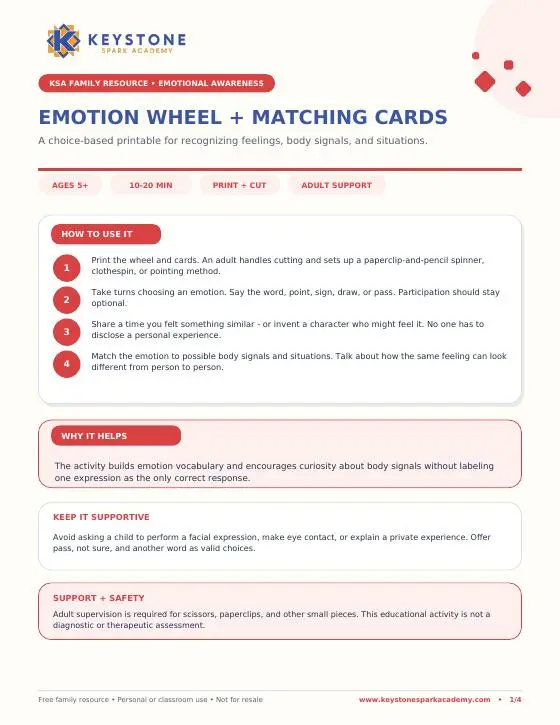
Cover of the Emotion Wheel and Matching Cards printable resource
The PDF is the printable companion. This webpage provides the structured screen-reader version.
Activity instructions

What you need

The printed wheel and cards, scissors used by an adult, and an optional paperclip-and-pencil spinner, clothespin, or pointing method.

How to do the activity

  1. Print the wheel and cards. An adult handles cutting and sets up a spinner, clothespin, or pointing method.
  2. Take turns choosing an emotion. Say the word, point, sign, draw, or pass. Participation should stay optional.
  3. Share a time you felt something similar, or invent a character who might feel it. No one has to disclose a personal experience.
  4. Match the emotion to possible body signals and situations. Talk about how the same feeling can look different from person to person.

Why it may help

The activity builds emotion vocabulary and encourages curiosity about body signals without labeling one expression as the only correct response.

Adaptation and communication options

Avoid asking a child to perform a facial expression, make eye contact, or explain a private experience. Offer pass, not sure, and another word as valid choices.

Visual information in words

Text description of the wheel and cards

The wheel has six equal sections surrounding the question: What fits right now? Joyful includes happy, excited, proud, and hopeful. Sad includes hurt, lonely, tired, and disappointed. Mad includes angry, annoyed, jealous, and frustrated.

Scared includes worried, nervous, unsure, and overwhelmed. Calm includes safe, peaceful, content, and relaxed. Surprised includes curious, confused, amazed, and startled. A feeling may fit more than one section or none of them.

The matching cards offer examples, not rules. Joyful may include smiling, movement, quiet contentment, or increased energy. Sad may include tears, quietness, low energy, needing closeness, or wanting space. Frustrated may include tight muscles, a faster voice, repeated attempts, shutting down, or needing a break.

Calm may include steady breathing, relaxed muscles, focused attention, movement, or comfortable quiet. Excited may include faster speech, movement, smiling, hand motions, quiet anticipation, or repeated questions. Scared may include a quick heartbeat, freezing, hiding, seeking reassurance, pacing, or wanting distance.

Choice belongs in the activity

Adapt, pause, communicate another way, or pass.

These educational resources are designed to support curiosity, communication, and connection. They are not diagnostic, medical, mental health, legal, or individualized educational advice.

Free KSA resource access

One quick step, then explore freely for 60 days.

Tell us who is using the resource. On this browser and device, you will not be asked again for 60 days when downloading another free KSA resource.

Resource access information is used to understand community interest and provide requested materials. Newsletter consent is optional. Read our Privacy notice.

Keystone Spark Academy updates

Keep the spark moving.

Receive occasional program, event, resource, and mission updates. We will not sell your information.